A Rainy-Day Run, Planned Around the Turnaround
Plan a rainy-day run around a clear turnaround and a modest route, so changing weather has a sensible answer before you leave the door.
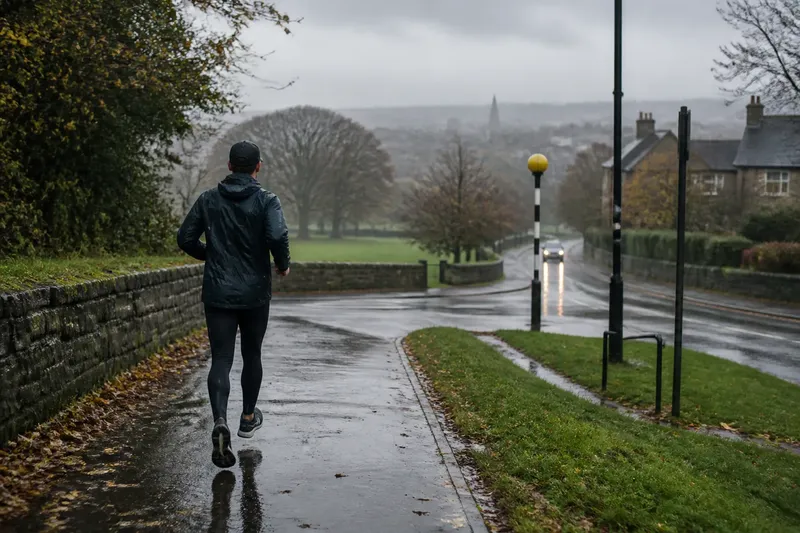
The common rainy-day mistake is to set a distance before deciding what would make the route unsuitable. A rainy-day run can then become an awkward negotiation with slippery paving, poor visibility or a route that offers no sensible way home. A better plan begins with what the rain changes: how you read the ground, cross streets and keep your attention on the surroundings.
That makes the outing less about finding a landmark and more about choosing a route whose surfaces and crossings remain legible in wet conditions. The useful question is not how far you meant to go, but whether the next stretch still makes sense.
What makes a rainy-day run route readable?
Choose streets or paths where the edges, crossings and direction are easy to see. Familiarity helps, but it is not enough on its own: a familiar riverside path may collect water, while a pavement under trees can hide uneven slabs beneath wet leaves.
Before leaving, think through the route as a sequence of surfaces. A paved park path may be comfortable in ordinary rain; a muddy shortcut can become slick, and a road crossing may be harder to judge through traffic spray. Prefer a route where you can avoid the questionable section without stepping into a worse one.
Do not rely on a map application to settle every choice once you are out. A screen can be difficult to read in rain, and looking down at it near traffic is a poor exchange. A simple route you can remember is more useful than a complicated one with attractive lines.
How should you judge the ground as you go?
Rain alters the small cues that make running feel routine. Shiny paving can conceal puddle depth; leaves can cover kerbs; painted road markings and metal covers may be slippery. Slow down where the surface changes, and choose a clear patch of pavement rather than trying to preserve your usual rhythm.
Pay attention to whether you can see and be seen. If spray, darkness or rain makes a crossing difficult to judge, wait for a clearer moment or use a safer crossing nearby. If water covers the path or a section looks unstable, take another route or head back rather than testing it at speed.
For a short outing, repeatedly checking several weather apps is not worth the effort. Check the local conditions before leaving, take any relevant warning seriously, then make decisions from what is actually happening on the route.
What should a rainy-day route plan answer?
Is an out-and-back route always safer than a loop?
No route shape is automatically safer. An out-and-back lets you recognise the ground on the return, while a loop can offer alternatives if its streets and paths are familiar and open.
What if a path is flooded?
Do not run through water if you cannot see the surface beneath it or judge its depth. Turn onto a known, safe route or return by the way you came; avoid entering a flooded roadway or path.
When should you stop running?
Stop if you feel unwell, unusually cold or unsteady, or if visibility and footing make continuing unsafe. Move to a safe place and seek assistance if the situation calls for it.
Do you need specialist clothing?
Not necessarily for a short outing in ordinary rain. Wear familiar clothing that remains comfortable when damp, and choose a light layer or cap if conditions call for them.
What should you check before setting out?
- Check whether local warnings, flooding or strong wind affect the route; if they do, postpone or choose a safer place, and if they do not, continue with a modest plan.
- Check whether the path has muddy, leaf-covered or water-prone sections; if it does, avoid those sections or choose another route, and if it does not, use the planned path while watching the surface.
- Check whether crossings are easy to see through likely spray and rain; if they are not, use a clearer crossing or change route, and if they are, cross cautiously when traffic permits.
- Check whether you can remember the route without consulting a screen; if you cannot, simplify it before leaving, and if you can, keep the phone available only as a backup if that is your usual practice.
- Check whether you have a straightforward way to return from each less familiar section; if you do not, remove that section, and if you do, keep the return route in mind.
- Check whether a dry layer, towel and place for wet shoes are ready at home; if they are not, set them out or accept that the return will be less comfortable, and if they are, leave without adding unnecessary kit.
How can you make the plan work in practice?
Say you have a familiar route from your front door through a park, but rain is forecast and the park’s lower path sometimes holds water. You decide before leaving to use the paved upper path, avoid the lower section, and return by the same streets. At the park entrance, you see that the upper path is clear, so you continue; on the way back, rain makes the main crossing hard to see, so you wait for a clear view and cross only when traffic permits. The resulting plan trades a longer wait for a more legible crossing, without relying on a detour you have not checked.
Prepare for the return as well as the outward run. Leave a towel by the door, set out a dry layer and put a clear space aside for wet shoes. Those small arrangements make coming home early an ordinary outcome rather than a reason to keep going in poor conditions.
What is not worth doing?
There is little point in buying specialist equipment for a short run before you know what discomfort you are trying to solve. A familiar cap, a suitable layer and a route that avoids treacherous surfaces may be enough; avoid adding kit that distracts from seeing where you are going.
A rainy-day run is easier to manage when the route is chosen for visible ground, sensible crossings and a return you can follow. Keep the phrase rainy-day run in mind as a practical question about conditions, not a target to complete: if the route stops being readable or you feel unwell, choose the safer way home.